ICANN — Own Your Name Before Someone Else Does
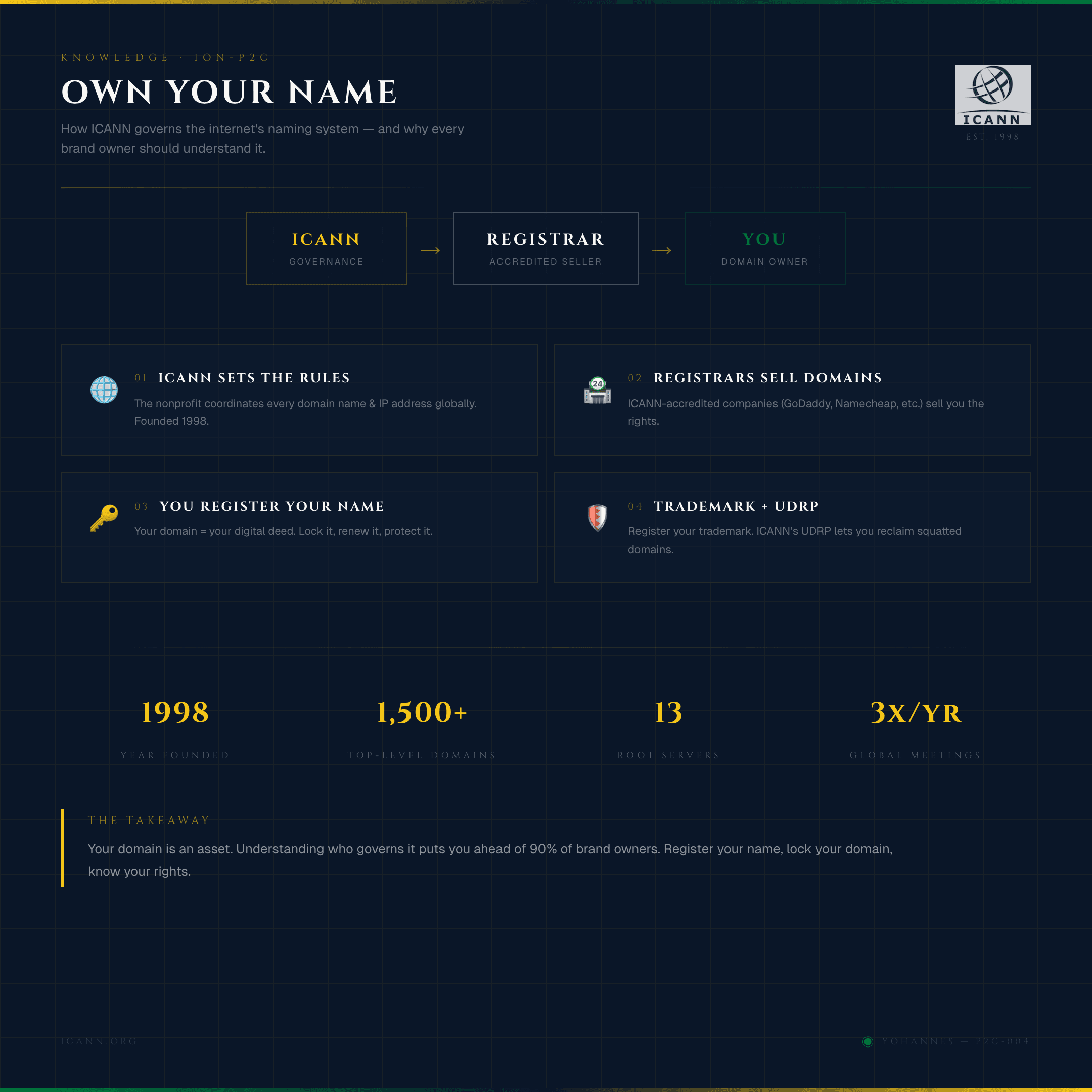
ICANN stands for the Internet Corporation for Assigned Names and Numbers. Formed in 1998, it’s the not-for-profit organization that coordinates the entire internet’s naming system: every domain name, every IP address, every top-level extension (.com, .org, .store, .music). Without ICANN, there would be no unified global internet. People from all over the world dedicate themselves to keeping the internet secure, stable, and interoperable through this organization. Why should you care? If you’re building a brand or business, your domain name is your digital deed. ICANN accredits the registrars (GoDaddy, Namecheap, Google Domains) that sell you that deed. Understanding this chain means you know your rights, like the fact that registrars can’t just take your domain, that WHOIS records are public unless you opt into privacy protection, and that ICANN’s UDRP (Uniform Domain-Name Dispute Resolution Policy) is how trademark holders reclaim domains from squatters. Some things worth knowing: • ICANN oversees the DNS, the system that converts IP addresses (like 192.0.32.7) into human-readable names (like icann.org). Every time you type a URL, ICANN’s infrastructure is at work. • There are over 1,500 top-level domains now. Beyond .com, extensions like .brand, .store, and .io exist because ICANN opened applications for new gTLDs in 2012. • Domain disputes are real. If someone registers your brand name as a domain, ICANN’s UDRP process lets you file a claim, but only if you have a registered trademark. Protect your name early. • ICANN coordinates 13 root servers that maintain the internet’s main address index. These are the backbone of the entire system. • Your registrar is not the same as your host. ICANN governs the registrar relationship. If your registrar goes under, ICANN policy ensures your domain transfers to another accredited registrar. • ICANN meetings happen three times a year across the globe. The policies made there affect every business with a website. Most small business owners have no idea these decisions are being made. The takeaway: your domain is an asset. Understanding who governs it and how the system works puts you ahead of 90% of brand owners who treat their web presence as an afterthought. Register your name, lock your domain, and know your rights.